
Hello everyone, and welcome to another issue of Words for Worlds.
This past week, the World Book Fair has been on in New Delhi. Visiting the World Book Fair has been an annual ritual for almost three decades (at least, the years I’ve been in Delhi). As a child, my parents would take me there (if memory serves me right, in the 1990s it happened once every two years; now, it’s annual). Back then, the Scholastic and Bloomsbury stalls were the main attractions for an eight-year-old. In 2000, I recall getting a hardback of Harry Potter and the Prisoner of Azkaban (childhood indiscretions, I judge myself for it now) before it was available in Indian bookshops. The World Book Fair was one of the most magical places in my little child’s world. Lunch at an outdoor food stall in between hall-hopping didn’t hurt the mystique either.
Decades have passed. Books are now much more easily available, whether through ordering via your local bookshop or - where that’s not possible - online. Meanwile, some of the buildings that housed the Book Fair at Pragati Maidan have been torn down. The Book Fair itself has shrunk. Its character has changed. It has become a lot more “governmentalised,” if that’s a word. With that, for many people, the magic has gone. To an extent, that’s true; and yet, something remains. My go-to places have changed from Scholastic and Bloomsbury to Aakar Books and Speaking Tiger (among others). Still there are things you chance upon at the World Book Fair that you simply won’t elsewhere. I always come back home with my fingers aching from holding multiple bags from multiple stalls. And, come what may, there will always be a sprinkling of magic dust in a huge hall with books in all directions, and people among the books.
This year, as always, I came back with a stash - which I will go through in the coming weeks, and talk about it here.
On another note, happy 24th Birthday to Blossoms Bookshop. Its massive second-hand collection made it the most important place in my life between the ages of 17-22, when I was reading for my undergraduate degree in Bangalore. So if you’re reading this, and you’re Bangalorean, drop by and support one of its most venerable institutions.
What I’m Reading
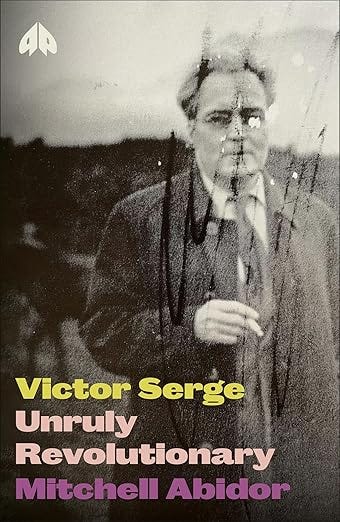
Anyone who has followed this newsletter for a while knows that I am fascinated by the life and work of Victor Serge. Ever since I read the stunning Unforgiving Years many decades ago, I have tried to read everything I can by - and about - him (a project facilitated by NYRB republishing a lot of his novels). As an artist, as an anarchist, and as a person, my view of him is - I think - a view shared by many others: deep respect, tinged with admiration, primarily for a man with moral integrity, who refused to compromise on it, and who paid a staggering price for his refusal.
I came across Unruly Revolutionary through a Boston Review interview with the author, Mitchell Abidor. As the title - Turncoat Radical - suggested, the interview promised to upend this widely held view about Serge. After reading it, I came across the book itself at the World Book Fair. I bought it with some trepidation: I was expecting revelations that would create the kind of jarring dissonance I felt when I read Patti Smith casually talking about playing a “harmony” concert in Tel Aviv in the 1990s. Never meet your heroes - and never find out too much about them either.
This impression is fortified when you read the book’s introduction, where Abidor is almost apologetic about what follows. And yet, the book itself is not quite near the character deconstruction that the interview suggests. To start with, let me note that it is an excellent biography: rigorous, detailed, excellently written, and - as biographies of such figures should do - crystallises the era in the person, and the person in the era.
Now, as for Serge himself: the book does not so much deconstruct him as much as it humanises him. Abidor does an excellent work of setting the context through which a lot of Serge’s writing and actions - which might otherwise seem inconsistent - make sense. What emerges is - in anarchism’s classic formulation - “neither a god nor a master,” but a human being with all his human flaws - flaws that are accentuated and amplified because of the nature of the times in which Serge lived. Thus, we do not excuse - for example - his support of the bloody suppression by the Soviet Union of the Kronstadt Rebellion, but we can understand it - an understanding that is informed by his subsequent and public change of a view, a change that he paid a high price for.
The most serious charge that Abidor claims to lay against Serge is that towards the end of his life, he became not just anti-Stalinist but anti-communist, to the point where - akin to George Orwell - he was involved in making lists and reflexively supporting the US. Unlike Orwell, however, Serge died in 1947 (an early death, hastened by privation and exile). At the time he died, institutional and governmental communism was Stalinism: other variants had been stamped out. From the vantage point of 2025, we can distinguish the two, but in 1945, that would have been a much more difficult task. At the time, even McCarthyism had not yet entered the picture. One thing about Serge that this book brings out very clearly is his ability to change his mind as the reality around him changed. With that quality, there is no reason to believe that, confronted with reality of the Cold War, and of the militant decolonisation movements that swept the world in the 1950s and 1960s, Serge would not have changed his mind again - I rather believe he would have.
We will never know, but perhaps Abidor here is a victim of his own success: the portrait he paints of Serge is so nuanced and - despite everything - sympathetic, that both at his best and at his worst, he is a figure that we can continue to admire as quintessentially human, and bearing the best of human courage as well as (on occasion) the worst of human short-sightedness - but never human evil.
For that alone, and for everything else, this is a book worth reading.
What’s Happening at Strange Horizons
Take a look at the Feminist Futurisms round-table - from last year’s WorldCon - featuring some known and familiar names.
The Indian Scene
Submissions for Volume 2 of the IF Anthology of New Indian SFF are still open. Submit your story here.
Recommendations Corner
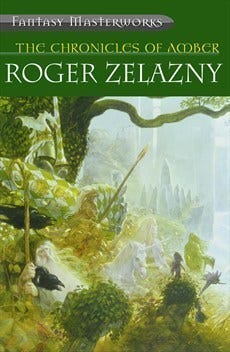
Last Sunday, for the Delhi Science Fiction Reading Circle, we had a lot of fun talking about Roger Zelazny’s Lord of Light. Apart from the utterly chaotic nature of that book, as I (re-)read it, I thought to myself that it really was a fantasy novel trapped in the science fiction form. And that made me remember Zelazny’s actual (serialised) high fantasy novel, The Chronicles of Amber, which hasn’t quite enjoyed the kind of resurgence some other books from that era have had. This is a pity, because reading that book was sheer joy, the kind of joy that high fantasy should give you. I still recall the grandeur of the opening scene, where characters are introduced like the dramatis personae of a Shakespearean drama, the scenes of dream-travel, which are Zelazny at his best, and which Jordan would use to great effect in Wheel of Time a few years later, and the twin themes of war-and-quest that Zelazny completely nails. I will need to re-read the book to see how well it holds up (I was a teenager when I first read it), but if you’re someone who hasn’t yet read it, I wish you the joy of first discovery.
Thanks, its time for me to re-read a few of my favourite fantasy series!
Fantasy-seeming things during the mid-1900s were often couched in sci-fi terms--Shannara was post-apocalyptic, Pern's dragons were genetically engineered, etc. I'd say it's equally true that today's sci-fi often has fantastical elements. Both reaching for the more popular genre of their time, perhaps.