
Hello everyone, and welcome to another issue of the Words for Worlds newsletter.
What I’m Reading/Watching
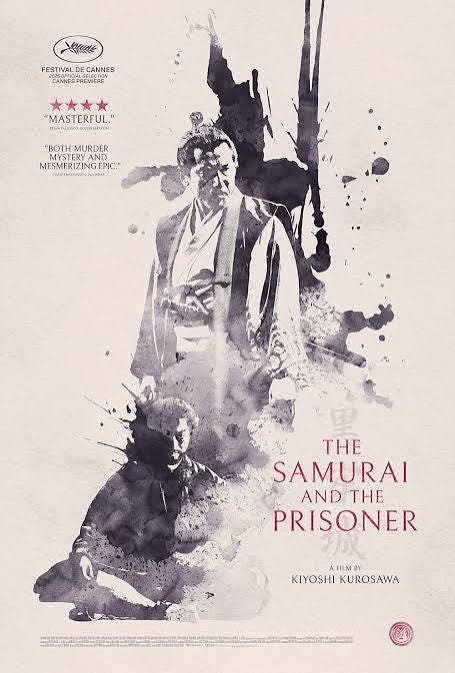
I’ve long loved Japanese crime fiction (speaking of which, RIP Keigo Higashino - nobody ever did it better), as well as my few forays into Japanese historical fiction (The Third Love and Shogun). So, when I heard about The Samurai and the Prisoner - a locked-room murder mystery set during Edo-era Japan, and currently only playing at film festivals - I had to track it down, with some difficulty. I’m glad I did, because it was absolutely worth it.
The Samurai and the Prisoner follows Araki Murashige’s rebellion against the warlord Oda Nobunaga, who is bent on conquering all of Japan. As Murashige waits for Nobunaga’s attack within the walls of his Akioka Castle, a series of strange murders ensue. To solve them, Murashige enlists the help of Kuroda Kanbei, a brilliant strategist - and Nobunaga’s envoy - who Murashige has imprisoned in the dungeon underneath the castle. What ensues is a cat-and-mouse game of betrayal and detection, as the shadow of Nobunaga grows ever darker.
To be fair, The Samurai and the Prisoner is not really a locked-room murder mystery: only the first murder approximates a locked-room mystery, and it is resolved swiftly enough. The other murders are macabre in their own way, but very soon it becomes clear that - as with a Higashino novel - the why is far more important than the how. Here is where the depth of The Samurai and the Prisoner comes in: Murashige is an unusual war leader for his time, in that he does not believe in killing. He finds it both distasteful and unnecessary. Wherever he can, he prefers to spare life rather than take it; but this brings him into direct conflict with the Samurai Code, where you are both expected to take life - and to yield it up, when the code demands it.
Thus, from the beginning Murashige’s leadership is tested and his decisions questioned (or simply not understood, leading to a constant, underlying tension - a tension which is ultimately resolved through the series of murders). Soon enough, The Samurai and the Prisoner thus stops being about the crimes themselves, instead centring all the dilemmas - and agonies - of a man who is fundamentally out of time and out of place, and who thus finds himself struggling against not only his enemy, but against the tides of the era themselves. The murders are masterfully woven into this story, and it is that which gives them their unique poignancy - and the final denouement its particular force.
When I interviewed Nicholas Boggs - James Baldwin’s biographer - earlier this summer, he mentioned - in response to a question - that Colm Toibin and Teju Cole are two of the most important contemporary writers on Baldwin. Reading Toibin’s On James Baldwin, it is easy to see why: this is a book that is, essentially, a dialogue between Toibin and Baldwin, where the former speaks through his life experiences, and the latter through his words. Like Baldwin, Toibin is a writer, a writer who discovers his queerness as a teenager, and like Baldwin, Toibin comes very close to choosing a career in the seminary. There is also - one feels - an elective affinity between Baldwin’s blackness and Toibin’s Irishness.
All of this puts Toibin in a position where he can understand Baldwin with a depth and a sensitivity that is all his own: starting with the cadence of Baldwin’s sentences (and how their inflection is influenced by church sermons), to his literary roots in Henry James (another writer with whom Toibin has, elsewhere, engaged deeply), Baldwin’s own experiences both in the deep south and in New York and the formation of his humanity through those experiences - this is a book that makes Baldwin’s words ring all over again.
Another one that sets up as a murder mystery to start with, and then swiftly turns into something else altogether: in Alastair Reynold’s Halcyon Days, the deaths of two scions of two wealthy clans that control a Generation Ship that is only about half-a-century away from its destination, raises the hackles of down-on-his-luck private investigator “Yuri Gagarin” (the name is itself the setting for a story of its own). Obviously, his investigation runs into immediate roadblocks, involving intransigence, injury, and further death - before, piece by piece, the true nature of the Generation Ship begins to unravel.
In many ways, Halcyon Days reminded me of another of my favourites - and very underrated - stand-alone Reynolds novel, Century Rain: the two novels move seamlessly between noir and space opera, held together by world-altering secrets that are revealed like daggers to the heart. I think I also have a specific soft spot for Halcyon Days because the nature of the reveal is actually - in a certain abstract way - similar to the core premise of my first two novels, The Wall and The Horizon duology (and as Halcyon Days came after those books were written, I can thankfully steer clear of unconscious … influence). I would say, though, that it would be particularly interesting to read Century Rain and Halcyon Days together, as complementary novels.
Strangely enough, while I’ve read Books 1, 3, and 4 of Tchaikovsky’s Children Of… series, this is one that has eluded me, with a couple of aborted attempts. I finally did have to read it, because I was leading a book discussion on it as part of Champaca Bookshop’s six-book science fiction book-box that I’ve been curating (the accompanying book was Arkady Martine’s A Memory Called Empire, and we talked about both books as space opera novels). This is, of course, the sequel to Children of Time: the conglomeration of Spiders, Humans, and the genius ship-mind Avrana Kern now set forth to explore, and chance upon a planet with both a race of highly evolved and fractious octopi, and a ruinous, particularly creepy virus/parasite. As with this series, Tchaikovsky moves between past and present, with the past showing us the sequence of events that led to the evolution of the octopus species as well as the initial takeover by the virus, and the present tracking the First Contact between the species.
I don’t think Children of Ruin has the propulsive quality of Children of Time, but it is compelling nonetheless: indeed, one of the most interesting points about the book came from one of the participants of the book club, when they noted that the octopus’s decentralised brain and nervous system was perhaps reflected in the seemingly haphazard and chaotically decentralised character of the intelligent octopus societies that the Spider/Human society from Children of Time encounters in the sequel. This hadn’t struck me when I’d read the book, and it did lead to me retrospectively scaling up my opinion of it.
What’s Happening at Strange Horizons
Here is Cat Fitzpatrick’s review of What We Are Seeking - a book that everyone is talking about, and that I had violently conflicted opinions about.
The Indian Scene
We are inviting a second round of submissions for Volume 2 of the Westland IF Anthology of New Indian Science Fiction - watch the Westland Instagram page for more details when it goes live (sometime today).
Recommendations Corner
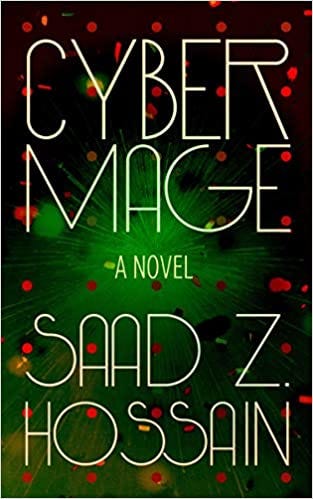
I didn’t want to curate the Champaca Book Box without a single text from South Asia (loosely, so-called!), so the climate fiction sub-category let me bring in Saad Z. Hossain’s Cyber Mage; if you’re part of the Book Box, you’ll be getting a copy, and if you’re not, I recommend getting one anyway: this near-future novel has Dhaka sinking beneath the waves as the climate catastrophe intensifies, while a set of geeky gamers race to save it: Hossain does wry humour and deadpan irony brilliantly, as readers of Djinn City probably know, and Cyber Mage is - I think - his most mature and completed work.