
Hello everyone, and welcome to another issue of the Words for Worlds newsletter.
A reminder that pre-orders remain open for THE FIFTH INFLECTION, and it’s also on Netgalley.
What I’m Reading
Any genre of writing, I believe, is built upon a compact between the writer and the reader. Over the years, that genre has been constituted by a set of conventions, tropes, and structuring features that have given it a recognisable shape and outline. The compact between the writer and the reader entails that if the writer presents a book as belonging to a certain genre, and the reader picks it up on the strength of that claim, then the reader is entitled to expect - no more and no less - that shape and outline to be maintained.
So, for readers who’ve come to epic fantasy through Tolkien, Robert Jordan, George R.R. Martin, Robin Hobb or - more recently - Steven Erikson or Brandon Sanderson (to take just a few names) - there is a shared, unspoken understanding of what makes something epic fantasy. That is not to say that expectations cannot be subverted, or that there is no space for creativity, individuality, or experimentation. but even the most experimental and expectation-subverting fantasy novels - say, for example, The Traitor Baru Cormorant - still has that shape and outline. Indeed, it is the preservation of the outline that allows for experimentation within it.
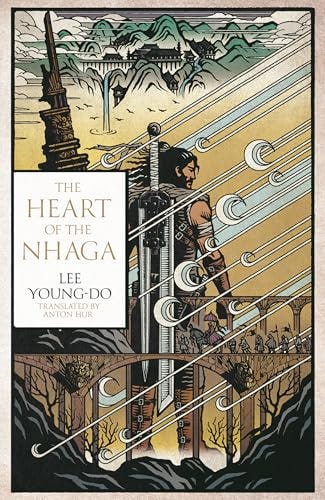
But every once in a way, a book or a series comes along that subverts the outline itself. Marlon James’ Black Leopard, Red Wolf and Moon Witch, Spider King are excellent examples: fantasy novels, yes, but radically defamiliarising our most basic expectations of what fantasy is supposed to be doing, and how it goes about doing it (as I wrote here and here). And so is the Korean novelist Lee Young-Do’s The Heart of the Nhaga, now available in an English translation by Anton Hur.
To understand the defamiliarisation running through The Heart of the Nhaga, start with a thought experiment: imagine The Lord of the Rings written in alternating chapters featuring the p.o.v.s of Frodo and a mid-ranking Orc in Mordor. It’s virtually impossible to imagine, because that book would no longer be The Lord of the Rings. Epic fantasy - whether operating through the clean-cut dark/light binaries of Tolkien, or the more nuanced variants of his successors - ends up constructing narrative hierarchies of this kind. This is completely missing from The Heart of the Nhaga.
The world of The Heart of the Nhaga has four different species: human, Tokkebi (a species that can manipulate fire both in the real world and as illusion), Rekon (a huge bird-species), and Nhaga. The first three live in fractious discord north of the “Line of Limit.” South of the Line of Limit are the Nhaga: a reptilian species who love trees and build forests, suppress the minds of animals and make them do their bidding, cut out their hearts in exchange for effective immortality, and in whose society patriarchy has been entirely inverted. The first three species hate and fear the Nhaga, and do not dare venture beyond the Line of Limit.
But all that changes when a group of three - a human, a Tokkebi, and a Rekon (one may even call them a fellowship) are charged with going south and exfiltrating a Nhaga double-agent for a mysterious purpose. Once they get there, however, they find that the original double-agent has been murdered, and that his replacement ran away from his people before his heart could be extracted - making him painfully mortal. To make matters worse, the substitute has been falsely accused of committing the murder itself, and is being chased by his own sister, who has been commanded to kill him in repayment of the blood debt owed to the murdered Nhaga’s family. Cue a desperate cat-and-mouse game in the forest and beyond, featuring a cohort of the undead, a flying “beetles,” a massive tiger who may or may not be mind-suppressed, and many men-who-would-be-king.
If all this sounds chaotic, it is. The Heart of the Nhaga - told through the alternating p.o.v.s of the fellowship of the three and of the Nhaga themselves - is delicious chaos from beginning to end. In its dizzy proliferation of species, characters, motivations, intrigue, and and inter and intra-species politics, it is reminiscent of Marlon James (albeit without quite the same degree of gratuitously brutal violence), but very much its own thing. But what truly sets apart The Heart of the Nhaga is how Lee Young-Do, having committed to a non-anthropomorphic narrative, commits absolutely all the way through: the interior landscape of the Nhaga is painted with the utmost detail and care, and Lee Young-Do achieves here the immensely difficult task of simultaneously creating a world both utterly alien but also legible. The same is done, to a lesser extent, with the Tokkebi and the Rekon.
The other thing that Lee Young-Do commits all the way through is the inverted gender structure of the Nhaga. Of course, since the beginning of the genre, writers have imagined non-patriarchal and anti-patriarchal worlds, and even worlds where women have extraordinary coercive powers (think The Power). But The Heart of the Nhaga is perhaps the first work I’ve read where the inversion is depicted with a remorseless logic at every level of society, and that logic is taken to its absolute extreme:
Ryun - you and me, we’re not only made of what that man gave us. If you really want to use silly words like “father,” you have to call every animal your mother ate and every drop of water she drank your father as well. It makes no sense, right? (82-83).
It’s a logic that is, at the same time, fascinating, disturbing, defamiliarising, and disorienting in its consequences. Indeed, to read The Heart of the Nhaga is to be constantly unsettled.
This is a book that does retain at least some of the core outlines of the fantasy novel: if - according to Lin Carter - the two pillars of fantasy are the quest and the war, then The Heart of the Nhaga has a quest, and brings the readers to the cusp of war (one does feel that there is a lot of set-up going on for a war in the sequel). But nothing about the quest - or the oncoming war, for that matter - has any kind of familiarity beyond the threshold. This is heightened by the fact that The Heart of the Nhaga has as many registers as it has species: we are treated to the most un-epic fantasy-like moments of both slapstick and wry-dark humour (imagine if Terry Pratchett was to insert a chapter into The Lord of the Rings), and moments of political philosophising, especially on questions of kingship and rule. Somehow, midway through, The Heart of the Nhaga turns into an anti-monarchic screed, and it’s not even particularly subtle about it:
You, like everyone else, know nothing of kings. Until you know what a king is, do not try to make kings out of your chiefs. You must not try to make things you do not understand. But you can still make great chiefs. And a great chief is greater than the greatest king. Because they have the power to make people prosper.
The Heart of the Nhaga ends on a tantalising note - a cliffhanger, even. One gets the feeling that a lot of the payoff is reserved for the sequel. But whatever the sequel gives us, this is a fantasy series that is unique in every sense of the word, both intentional and unapologetic about what it is doing, and - most importantly - possessed of the imaginative range and virtuosity that makes it all come together brilliantly despite the breaking of the compact.
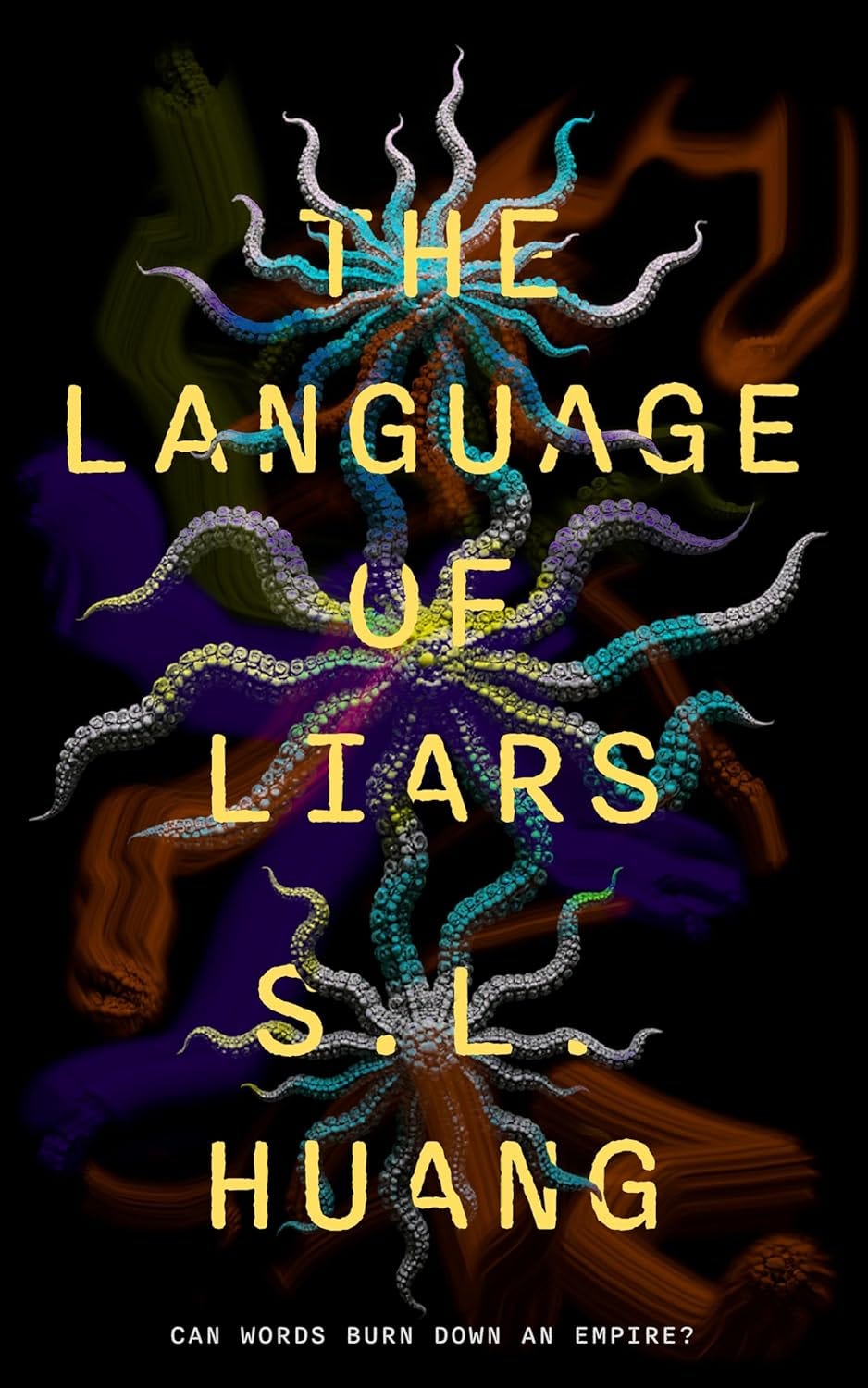
Sticking the ending is notoriously hard. There are a lot of books that do brilliantly for the first 95% of the story, and then produce an ending that make you want to shake the author by the scruff of the neck for letting down their own creation and their own characters. And then, sometimes, you come across the opposite: a story that is meandering along, interesting and well-done, but not particularly memorable - and then it delivers such a deliciously vicious sting in the tail that retrospectively alters the entire novel, raising it to the echelons of brilliant achievement. The Language of Liars is just such a novel (or, technically, novella).
The Language of Liars is set in a multi-species galaxy, which runs on a substance called the meridien, which allows for inter-stellar travel. Only one species can mine the meridien, and they are called the star-eaters. Conveniently, the star-eaters appear to have no desire other than to mine meridien, and so - under benign oversight - they do so in continuing shifts. But a problem is looming over the horizon: the star-eaters have ceased to reproduce, and when asked about it, they only say “the body knows when.” If the star-eaters die out - as they will in a few centuries - galactic civilisation will collapse, unless an alternative is found.
The protagonist of the story is Ro, a linguist of the Orro species (particularly dependent on meridien); the Orro linguists have the unique ability to “jump” into another species (that is, occupy their mental frameworks), and - much to this own surprise - Ro succeeds in jumping into a star-eater’s mind, for the first time in remembered history. While he begins with the objective of inter-cultural study and better understanding of another species, his own success soon leads him into a high-stakes struggle to discover why the star-eaters have stopped reproducing.
Any more would be to reveal the “sting in the tail” that I’ve talked about, so all I’ll say here is that in The Language of Liars, S.L. Huang manages to pack in sophisticated critiques of anthropology, linguistic pyrotechnics, and some classic space opera moments, all within the limited space of a novella - and then the ending. Come for the detailed excursions into inter-species language in the tradition of Babel-17, Embassytown, and The Story of Your Life - and stay for the emotional devastation wrought by the final three chapters.
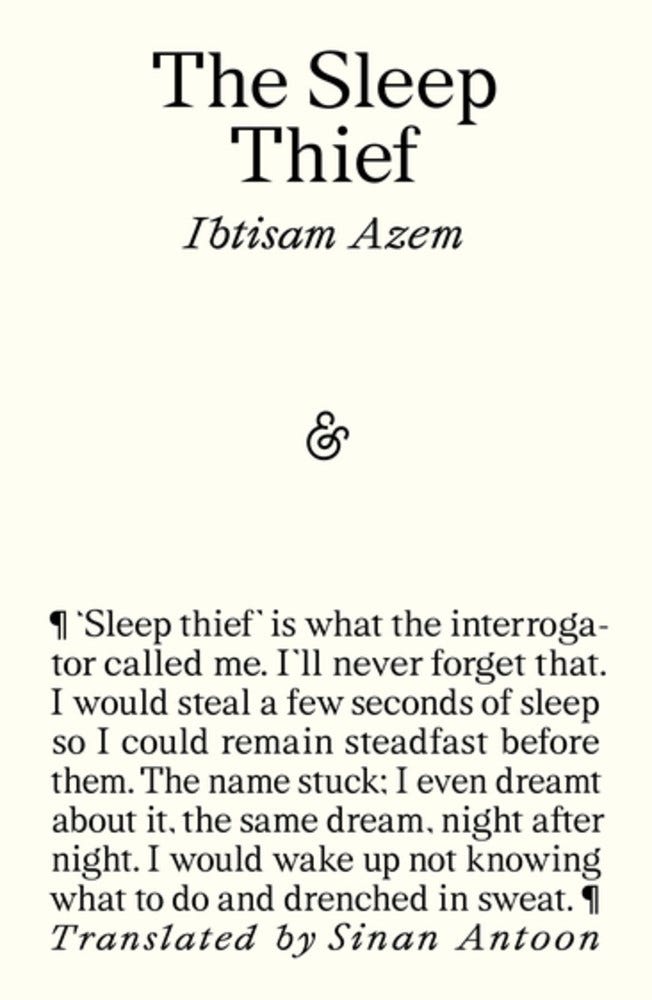
Many years ago, I interviewed Ibtisam Azem about her brilliant novel, The Book of Disappearance (it would go on to be shortlisted for the International Booker). The Sleep Thief technically precedes The Book of Disappearance - it was Azem’s Arabic debut - but has only now come out in an English translation by Sinan Antoon (one suspects it might have been the International Booker shortlisting that made that possible!).
The Sleep Thief is very different from The Book of Disappearance: if I had to characterise it, I’d call it Emile Habiby’s Saeed the Pessoptimist, updated for 2026. Habiby’s iconic book is indirectly referenced early on in the novel, and the influence is clear: like the eponymous Saeed of Saeed the Pessoptimist, Gharif, the narrator of The Sleep Thief, is a Palestinian citizen of the State of Israel; he is - understandably - a somewhat unreliable narrator, and the book itself - like Saeed the Pessoptimist - proceeds in the form of a mosaic novel, a series of loosely connected montages about Gharif’s life, from Haifa to Jaffa to Tel Aviv to Jerusalem, interspersed with the very quotidian, very banal everyday brutalities of life in the State of Israel (the “sleep thief” refers to Gharif’s ability to steal a moment of sleep through brutal interrogation, much to his interrogators’ chagrin).
I don’t like remembering street names, because each street has two: the one that is written and the one warring with memory. Their names and ours. Even when one of ours and one of theirs are the same, the names still have stolen taste. Names. I don’t like that plural. When I utter it, I feel that I am without features. I thought a lot about going to some Greek island and claiming amnesia. No one would know anything about me. I could forget who I was. But this thought brought me no comfort.
The voice is all Azem’s, but one can hardly refrain from seeing the wry tone of Habiby underneath it: The Sleep Thief is a palimpsest novel, both in style but also in authorial voice: very much its own, but also, a most fitting tribute to Emile Habiby.
What’s Happening at Strange Horizons
The 31 August special issue is on internet culture.
Also, R.U.R. and Arcane are, separately, two of my favourite pieces of SFF (well, not counting Season 2 of Arcane!), so it was great to see this essay bringing the two together: “Move Fast and Don’t Ask Permission: Techno-Optimism in R.U.R. and Arcane.”
The Indian Scene
Congratulations to Chaitanya Murali on the publication of “Of Black Town’s Monster” (parts one and two) in Podcastle! Give it a listen/read.
We’re now accepting a second round of submissions for the IF Anthology of New Indian Science Fiction. For details, click here.
Recommendations Corner
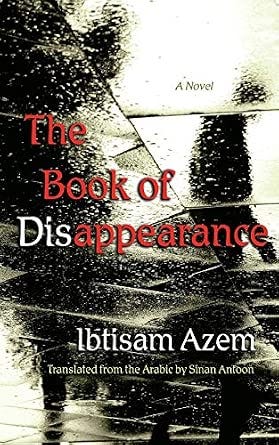
Since The Sleep Thief is just out, what better time than this to go back and familiarise - or re-familiarise - yourself with Ibtisam Azem’s first novel published in English, The Book of Disappearance: a book set on a morning when all Palestinians mysteriously disappear from the State of Israel, and what follows.